Scammers are getting smarter every year. WhatsApp has become one of the top platforms used by online scammers – especially for buyers and sellers on Facebook Marketplace, SMS, Shopee, TikTok Shop, Mudah, Telegram, and Instagram.
Today, one of the most common scam tricks is sending a fake WhatsApp link, usually in the format: Your account has violated the Terms of Use and will be blocked within 24 hours. Please log in to the Security Center to verify https://whtsapp.dev/?s=ltr
WhatsApp scams are exploding worldwide – especially in Malaysia, Singapore, India and UAE.
Every day people receive messages asking for:
- OTP codes
- Account verification
- Payment updates
- Parcel delivery
- Money transfers
- Fake suspension notices
Most people don’t know how to identify if a message is real or dangerous.
That’s exactly why this WhatsApp Scam Message Checker exists.
It uses rule-based pattern analysis to detect:
- Phishing keywords
- Malicious links
- URL shorteners
- Fake “suspension” messages
- OTP harvesting tricks
- Urgency tricks (“Send now”, “Immediate action required”)
- Impersonation cues
Paste any message → the tool highlights suspicious parts → gives a safety score.
wa.me/XXXXXXXXXX
api.whatsapp.com/send?phone=…
bit.ly → wa.me
tinyurl.com → wa.me
Some links look real, but they are modified to steal data, redirect you to phishing pages, or connect you to a scammer pretending to be a real buyer/seller.
Why WhatsApp Links Are Dangerous Now?
Scammers use WhatsApp links to:
✔ Pretend to be a buyer
They send you a wa.me link to “confirm payment” — but actually redirect to a phishing payment page.
✔ Fake delivery companies
Common scam trick:
“We already send parcel. Please pay small delivery fee at this WhatsApp link.”
✔ Hijack your WhatsApp
Fake links trick users into giving verification codes.
✔ Masked short links
Scammers hide their WhatsApp link inside a short URL (bit.ly / tinyurl).
✔ Redirect through multiple unsafe domains
Modified links that look like WhatsApp but aren’t.
How the WhatsApp Link Safety Checker Works?
Our tool scans your link instantly and checks for:
✔ Non-official domains
Only these are real:
wa.meapi.whatsapp.comchat.whatsapp.com
Anything else = suspicious.
✔ Fake or malformed numbers
If the number doesn’t follow international format, it’s likely fake.
✔ Redirect parameters
Flags suspicious query parameters like:
redirect=...token=...auth=...ref=...id=...
These are common in phishing links.
✔ Shortened links
Scammers use:
- bit.ly
- tinyurl
- cutt.ly
- shorturl
Our tool automatically lowers the trust score if used.
✔ Overly long URLs
Very long links hide tracking or redirect payloads.
Why This Tool Is 100% Safe & Private?
Unlike other scanners, nothing is uploaded to any server.
Everything runs inside your browser only.
No saving. No logging. No tracking.
You can check sensitive links safely without worrying.
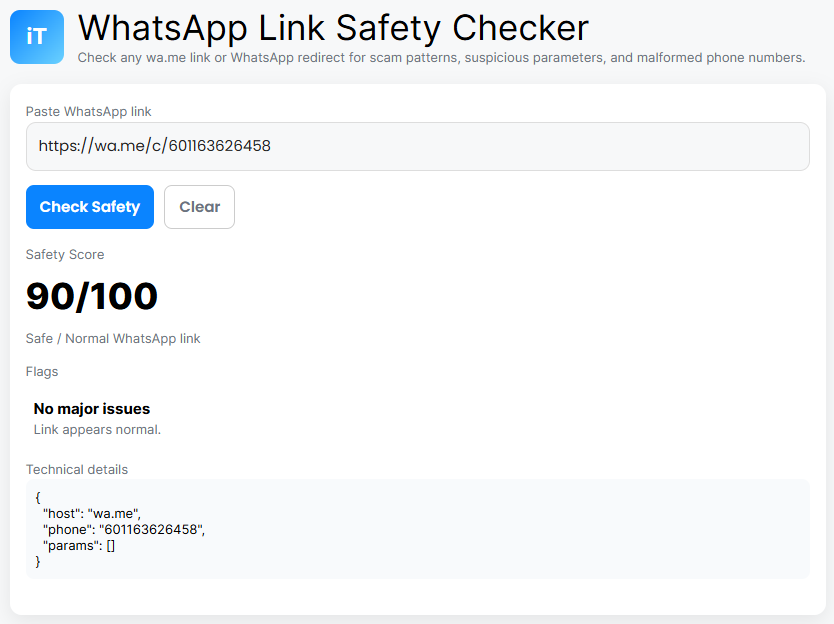
How to Use the Tool?
- Copy the WhatsApp link.
- Paste it into the checker.
- Click “Check Safety.”
- Get:
- A safety score
- Flags for potential scam
- Technical breakdown
- Final recommendation
🇲🇾 Top WhatsApp Scams in Malaysia (2025 Edition)
This section helps with GEO traffic and AI Overviews.
1. Bank Scam Messages
“Your account will be suspended. Verify here.”
2. PosLaju / courier scams
“Please pay RM1.50 to release parcel.”
3. Police / government impersonation
“You are involved in a criminal case…”
4. Investment scams
“Guaranteed daily income RM300…”
5. OTP hijacking attacks
“Send me the verification code mistakenly sent to you.”
Common WhatsApp Scam Examples:
1. Fake Buyer / Marketplace Scam
“Please confirm payment at this WhatsApp link.”
👉 100% scam.
2. Fake Courier / Delivery Fee Scam
“Your parcel is stuck. Pay RM1.20 at this link.”
👉 100% scam.
3. Fake Business Account
Scammer sends a fake wa.me link pretending to be a company.
4. Shortened WhatsApp Links
Bit.ly → Fake login page
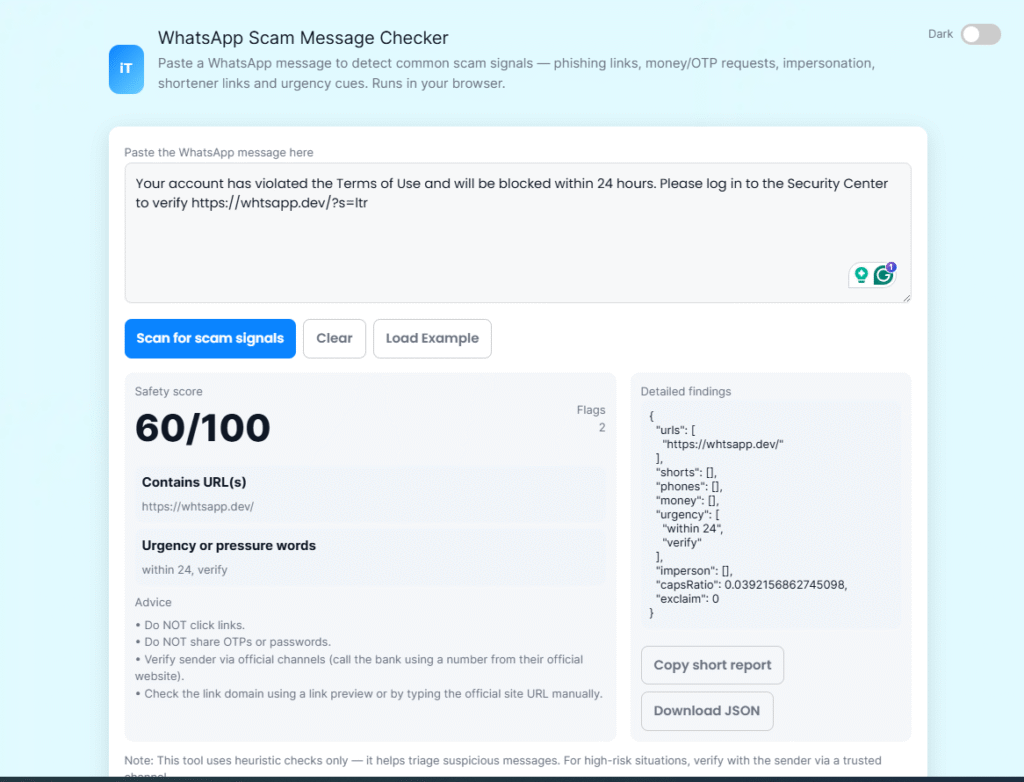
Your account has violated the Terms of Use and will be blocked within 24 hours. Please log in to the Security Center to verify https://whtsapp.dev/?s=ltr
Alert: Please dont click the above url link if you are in Malaysia: This Whatsapp message received by million in Malaysia.
Best FAQs:
“Is this WhatsApp message a scam?”
Paste the exact text into the tool. If it includes urgency, links, OTP requests, or impersonation, it’s a scam.
“How do I know if a WhatsApp link is safe?”
Check if the link is shortened, suspicious, unknown, or forces login. Use the checker to highlight risky parts.
“Can WhatsApp support ask for verification codes?”
Never. WhatsApp will NEVER ask for your OTP.
“What should I do if I clicked a scam link?”
Change passwords immediately and enable 2-factor authentication.
Common WhatsApp Scam Examples:
1. Fake Buyer / Marketplace Scam
“Please confirm payment at this WhatsApp link.100% scam.
2. Fake Courier / Delivery Fee Scam
“Your parcel is stuck. Pay RM1.20 at this link.”
100% scam.
3. Fake Business Account
Scammer sends a fake wa.me link pretending to be a company.
4. Shortened WhatsApp Links
Bit.ly → Fake login pageRed flag.
Tips to Stay Safe:
- Never trust shortened links.
- Always check number format.
- Don’t click if the buyer/seller is rushing you.
- Real companies never ask for WhatsApp verification codes.
- If unsure — run the link in the checker first.
Try the WhatsApp Link Safety Checker Now:
It’s free, fast, and private:
Use the tool above on iLuvTool.com
Save yourself from losing money, your WhatsApp account, or your personal details.
Related Tool: URL Phishing Checker → https://iluvtool.com/url-phishing-checker/
Stay safe online.
“Content reviewed and human-edited for accuracy.”